Do AI Detectors Work? Accuracy, False Positives and What to Do
Quick answer: AI detectors work only partly. They can often flag long, unedited passages written by AI, but they are not reliable proof. Independent studies find accuracy well below vendors’ claims, results drop sharply when text is edited or paraphrased, and human writing, especially formal writing and writing by non-native English speakers, is sometimes wrongly flagged. Treat an AI detection score as a reason for a conversation, never as a verdict on its own.
Key takeaways
- AI text detectors estimate probability based on patterns; they cannot see how a text was actually written.
- Vendors often report very high accuracy on their own tests; independent research usually finds lower, more variable results.
- False positives happen, and some groups of writers are flagged more often than others.
- Editing, paraphrasing and mixing human and AI writing make detection much less reliable.
- Turnitin itself says its AI score should not be the sole basis for action against a student.
- Drafts, version history and clear disclosure are better evidence of honest work than any detector score.
What is an AI detector?
An AI detector (or AI content detector) is a tool that estimates whether a piece of text was written by a person or generated by a language model such as ChatGPT, Claude or Gemini. Well-known examples include Turnitin’s AI writing detection, GPTZero, Copyleaks, Originality.ai, Winston AI and ZeroGPT. Many schools use them through their learning platforms, and some publishers and agencies use them to screen content.
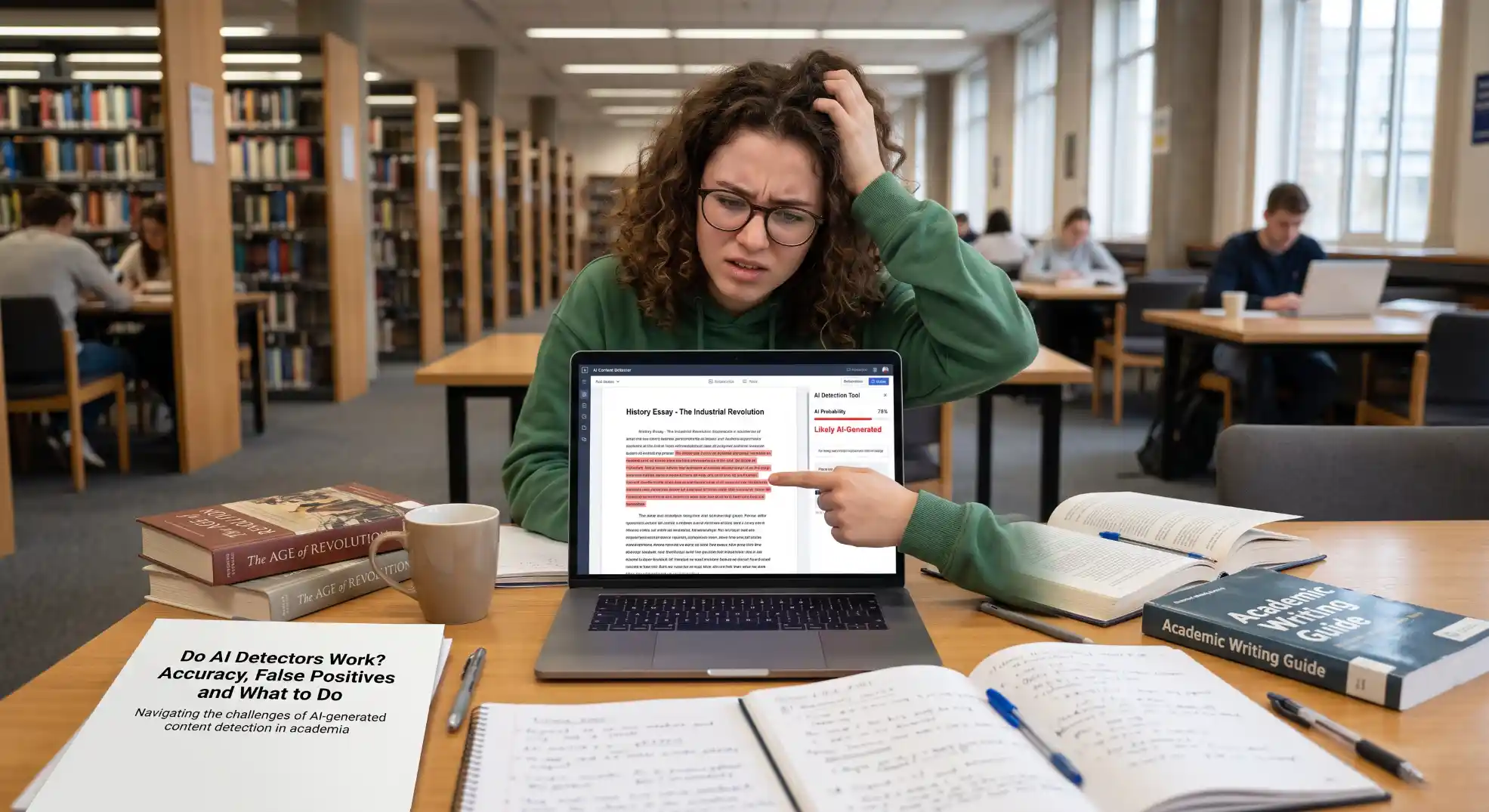
Most detectors return a percentage or a label, such as “likely AI” or “85% AI”, and sometimes highlight specific sentences. That number looks precise, but it is a statistical estimate, not a measurement of what actually happened.
How do AI detectors work?
Detectors are trained on large collections of human-written and AI-generated text and learn patterns that tend to differ between them. Common signals include:
- Perplexity: how predictable each word is to a language model. AI text often uses the most likely next word, so it tends to be more predictable.
- Burstiness: how much sentence length and structure vary. Human writing is often more uneven; AI text can be more uniform.
- Style features: common phrases, transitions, vocabulary and formatting habits associated with particular models.
- Classifier models: many tools use a trained neural network that weighs thousands of subtle features together.
The core weakness is clear from this list. A careful human writer can produce predictable, uniform text, and an edited AI draft can look varied and personal. The detector only sees the final text, not the process behind it.
How accurate are AI detectors?
Accuracy depends heavily on the tool, the model that wrote the text, the text length, the subject and how much the text was edited.
| Situation | Typical detector performance |
|---|---|
| Long, unedited text straight from a chatbot | Often detected, especially by stronger tools |
| Short text (a paragraph or two) | Unreliable; too little signal |
| AI text edited or paraphrased by a person | Detection drops significantly |
| Mixed human and AI writing | Hard to measure accurately; sentence-level flags vary |
| Formal, formulaic or technical human writing | Higher risk of false positives |
| Writing by non-native English speakers | Studies have found higher false positive rates |
| Text from newer models | Detectors can lag behind until retrained |
What vendors say vs what independent tests find
Detector companies frequently publish accuracy figures above 95% and very low false positive rates from their own benchmarks. Independent academic studies and journalist tests often report lower and more inconsistent results across tools, with some tools performing far worse than others and accuracy falling when text is paraphrased. The honest summary is that performance varies widely, and no tool is reliable enough to be treated as proof.
A telling example: OpenAI’s own classifier
In 2023, OpenAI released an AI text classifier and then withdrew it within months, citing its low rate of accuracy. If the company that builds the models found reliable detection difficult, it is a strong signal of how hard the problem is.
Bias against non-native English writers
A widely cited 2023 study by Stanford researchers found that several popular detectors frequently misclassified essays written by non-native English speakers as AI-generated, while performing well on essays by native speakers. Simpler vocabulary and more predictable sentence structures, which are common for language learners, resemble the patterns detectors associate with AI.
Why false positives happen
A false positive is when human writing is labeled as AI-generated. It is the most harmful kind of error, because it can lead to unfair accusations. Common causes include:
- Predictable writing: clear, simple, grammatically tidy sentences can look “machine-like” to a detector.
- Formulaic formats: lab reports, legal summaries, abstracts, definitions and five-paragraph essays follow standard patterns.
- Common topics: essays on popular subjects use the same facts and phrases found in countless texts.
- Grammar and editing tools: heavy use of grammar checkers or rewrite suggestions can smooth writing in ways detectors flag.
- Short samples: small amounts of text give the detector too little evidence.
- Translated text: writing translated from another language can look unusually uniform.
False negatives, AI text marked as human, also happen, especially after editing. That is why detectors should never be the only check in either direction.
How Turnitin’s AI detection works
Turnitin is the detector most students meet, because many universities and schools connect it to their learning platforms. Key points from Turnitin’s own guidance:
- Its AI writing report shows the percentage of qualifying text it predicts was generated by AI, and highlights segments.
- Scores between 1% and 19% are not shown as numbers; they are marked with an asterisk because false positives are more likely at low levels.
- Turnitin reports a document-level false positive rate under 1% for documents with 20% or more AI writing in its testing, and a higher sentence-level false positive rate.
- Turnitin states the tool may not always be accurate and should not be used as the sole basis for adverse action against a student.
In other words, even the vendor positions the score as one piece of information for a teacher to review, not an automatic judgment.
Does Canvas have AI detection?
Canvas is a learning management system, not an AI detector. On its own, it does not decide whether writing is AI-generated. Schools can connect third-party tools such as Turnitin to Canvas assignments, and those tools produce the similarity and AI reports that instructors see. Whether your course uses AI detection depends on your institution and your instructor’s settings, so check the syllabus or ask.
The same applies to other platforms such as Blackboard, Moodle and Google Classroom: detection comes from connected tools and school policy, not the platform itself.
Popular AI detectors compared
| Detector | Common users | Notes |
|---|---|---|
| Turnitin AI writing detection | Universities and schools | Built into institutional plagiarism checking; not available to individuals directly |
| GPTZero | Teachers, students, general users | Free tier plus paid plans; sentence highlighting and writing-process features |
| Copyleaks | Education and businesses | AI and plagiarism detection with integrations |
| Originality.ai | Publishers, SEO agencies, content teams | Paid, aimed at web content screening |
| Winston AI, ZeroGPT, others | General users | Varying quality; results can differ sharply between tools |
Running the same text through several detectors often gives very different scores. That inconsistency is itself a strong reason not to rely on any single result.
If you are a student flagged by an AI detector
Being flagged is stressful, but a detector score is not proof. Stay calm and focus on evidence of your process:
- Read your school’s policy: know what is allowed, what process applies and your right to respond.
- Gather evidence of your writing process: Google Docs or Microsoft 365 version history, earlier drafts, notes, outlines, research sources and browser history for research.
- Explain your process honestly: how you researched, planned and wrote. If you used any AI tools in allowed ways (for example grammar checking or brainstorming), say so clearly.
- Offer to discuss the work: being able to explain your arguments and sources in your own words is strong evidence of authorship.
- Ask what evidence is being used: politely ask whether the decision relies only on a detector score, and refer to the vendor’s own guidance that scores should not be the sole basis for action.
- Get support: academic advisors, student unions or ombuds offices can help you through the process.
Going forward, write in tools with version history, keep notes and drafts, and follow each course’s AI rules. If AI use is allowed, disclose how you used it.
For teachers: using AI detectors fairly
- Treat scores as a starting point: compare with the student’s previous work, in-class writing and knowledge of the topic.
- Talk before you decide: ask the student to explain their process and ideas. Honest writers can usually walk you through their thinking.
- Ask for process evidence: drafts, outlines and version history show how the work developed.
- Be aware of bias: non-native speakers and students who write in simple, formal styles face more false positives.
- Set clear AI policies: explain what AI use is allowed for each assignment, and how to disclose it.
- Design assessments that show thinking: personal reflection, local or class-specific examples, in-class writing, presentations and staged drafts are harder to outsource and easier to assess fairly.
For publishers, editors and businesses
Many content teams run submissions through AI detectors. A more useful question is not “was AI involved?” but “is this content accurate, original, useful and honest?”
- Google’s position: Google says it rewards helpful, reliable content however it is produced, while mass-produced low-value content can break its spam policies. See is AI content bad for SEO?
- Check quality directly: fact-check claims, look for original insight and first-hand experience, and check for plagiarism.
- Set a clear AI policy for writers: what is allowed, what must be disclosed and what is not acceptable.
- Do not rely on detector scores for payment disputes: review drafts and discuss the process instead, just as a teacher would.
For writers who use AI: work honestly
If you use AI tools for writing, the goal should be good, honest work, not beating a detector.
- Follow the rules of the setting: school, employer, client or publication.
- Disclose when required: many schools, journals and clients ask for a short note on how AI was used.
- Do the thinking yourself: use AI for brainstorming, outlining, feedback and editing, while the ideas, analysis and experience come from you.
- Edit thoroughly: check facts, add real examples and write in your own voice. Our guide on making AI writing sound human covers editing for quality and readers.
- Keep your drafts: version history protects you if your work is ever questioned.
We do not recommend “AI humanizer” tools that exist only to disguise AI text from detectors in settings where AI use is not allowed. They can introduce errors, and using them to hide prohibited AI use is still academic or professional misconduct. See AI humanizer tools: do they work? for a fuller look.
AI detection vs plagiarism detection
| Plagiarism detection | AI detection | |
|---|---|---|
| What it checks | Matches with existing sources | Statistical patterns typical of AI text |
| Evidence | Shows the matching source | Shows a probability, not a source |
| Verifiable? | Yes, you can compare texts directly | No direct way to verify the score |
| Main risk | Missed paraphrasing, common phrases flagged | False positives and false negatives |
This difference explains why plagiarism reports can be strong evidence while AI scores cannot: a plagiarism checker points to a real source you can inspect, but an AI score points to nothing concrete.
Better signals than detector scores
- Process evidence: drafts, notes and version history.
- Consistency: how the work compares with the writer’s previous work and in-person writing.
- Understanding: whether the writer can explain and defend the ideas.
- Accuracy: AI-written text sometimes contains invented sources, quotes or facts; checking citations is often revealing.
- Specificity: personal experience, class discussions and local details that a general model would not know.
Watermarking: a different approach to AI detection
Because pattern-based detection is unreliable, AI companies are also working on watermarking: hiding a statistical signal in AI-generated output when it is created. Google’s SynthID, for example, can watermark text generated by some Google products, as well as images, audio and video. A watermark checker looks for that signal rather than guessing from style.
Watermarking has limits too. It only works for text generated by tools that apply it, it can weaken when text is heavily edited or translated, and most models do not watermark text today. For images and video, provenance systems such as C2PA Content Credentials add another layer; see how to tell if an image or video is AI-generated.
Will AI detectors get better?
Detectors will keep improving, but so will language models, and the gap between human and AI writing keeps narrowing. Most researchers expect that reliable detection of edited AI text will remain very hard. The more durable solutions are social and procedural: clear rules about AI use, disclosure, assessments that show thinking, and provenance tools where they exist.
Quick reference: what an AI score does and does not tell you
| An AI score can suggest | An AI score cannot prove |
|---|---|
| Parts of the text look statistically similar to AI output | That a specific person used AI |
| A closer look or conversation may be useful | How much of the work was AI-written |
| Unedited chatbot output may be present | That writing without a flag is human-written |
| Where to focus a review | Intent, or a breach of any rule |
An illustrative scenario: one essay, three results
Imagine a student writes a history essay entirely by hand in Google Docs. Their style is clear and formal, with short, tidy sentences, partly because English is their second language and they rely on a grammar checker. The essay is run through three different detectors. One says “likely human”, one highlights a few paragraphs as “possibly AI”, and one gives a high AI percentage.
Nothing about the student’s work changed between the three checks; only the tool did. The fair next step is not to average the numbers but to look at the evidence that actually shows how the essay was made: the version history showing the essay growing over several days, the student’s notes and sources, and a short conversation in which the student explains their argument. In a case like this, the process evidence settles the question far more reliably than any score.
This scenario is illustrative, but it reflects a pattern that teachers and researchers report often: detectors disagree, and style features that have nothing to do with AI can push scores up.
AI detection at work and in hiring
Employers and recruiters sometimes run cover letters, reports or writing tests through AI detectors. The same limits apply. A better approach for employers is to state clearly whether AI assistance is acceptable, then evaluate what matters: accuracy, judgment and the ability to discuss the work. For candidates, honesty is the safest strategy. If you used AI to polish a cover letter, make sure every claim is true and that it sounds like you, because you will be asked about it in an interview.
Simple habits that protect honest writers
- Write in Google Docs, Microsoft Word online or another tool that keeps version history.
- Save outlines, research notes and early drafts, even messy ones.
- Keep a list of sources as you research, with links and dates.
- Note any AI tools you use and how, so disclosure is easy if needed.
- Include specific details from your own experience, class discussions or research that show your thinking.
Should you run your own work through an AI detector?
Some writers check their own work before submitting it. That can be reassuring, but be careful how you interpret the result. A high score on honest work does not mean you did anything wrong; it shows the tool’s limits. Rewriting good, clear writing just to lower a score can make it worse. A better use of your time is to make sure the work follows the rules, cites its sources properly and has your process documented. If you are worried, talk to your instructor or editor before submitting and ask how AI detection is used in their process.
The bottom line: AI detectors are a rough screening tool at best. Fair decisions come from evidence of process, honest conversations and clear rules, not from a single percentage on a screen.
Frequently asked questions
Do AI detectors actually work?
Partly. They can often detect long, unedited AI text, but accuracy varies widely by tool, drops when text is edited or paraphrased, and false positives happen. No detector is reliable enough to be proof on its own.
How accurate is Turnitin’s AI detector?
Turnitin reports a document-level false positive rate under 1% in its testing for documents with at least 20% AI writing, with higher error at the sentence level and for low scores, which it does not display as numbers. Turnitin also states the score should not be the sole basis for action against a student.
Can AI detectors be wrong?
Yes. They can flag human writing as AI (false positives) and miss AI writing (false negatives). Formal writing, short texts and writing by non-native English speakers carry a higher risk of false positives.
What AI detector do colleges use?
Many colleges use Turnitin’s AI writing detection through their learning platforms, while others use tools such as GPTZero or Copyleaks, or none at all. Policies vary by institution and even by course.
Does Canvas detect AI?
Canvas itself does not detect AI writing. Schools can connect tools such as Turnitin to Canvas assignments, which produce AI reports for instructors. Check your course syllabus or ask your instructor.
What should I do if I am falsely accused of using AI?
Stay calm, read the policy, and gather evidence of your writing process such as version history, drafts and notes. Explain your process, offer to discuss the work, and ask whether the decision relies only on a detector score.
Is it cheating to use AI for writing?
It depends on the rules of the setting. Some courses and employers allow AI for brainstorming or editing with disclosure; others forbid it. Follow the specific rules and disclose AI use when required.
What percentage on an AI detector is acceptable?
There is no universal safe number, because scores are estimates and vary between tools. Institutions set their own policies, and a score alone should never decide an outcome.